If someone has been stung
Get the sting out fast by scraping sideways with a fingernail or a card edge; pinching and pulling can squeeze in more venom. Wash the spot and hold a wrapped ice pack on it for 15 minutes. Noisy breathing, a swollen tongue or throat, wheezing, a change in voice, dizziness or collapse means anaphylaxis: use their adrenaline autoinjector if they have one and call 000. A child with 5 or more stings, or an adult with 10 or more, should see a doctor straight away.
How bees are handled in Victoria
Beekeepers first
In Victoria, the health department's guidance to pest controllers is to pass bee enquiries on to a beekeeper or to the Victorian Apiarists Association. Don't be surprised if a pest business suggests a beekeeper before anything else, especially for a swarm.
Hives must be registered
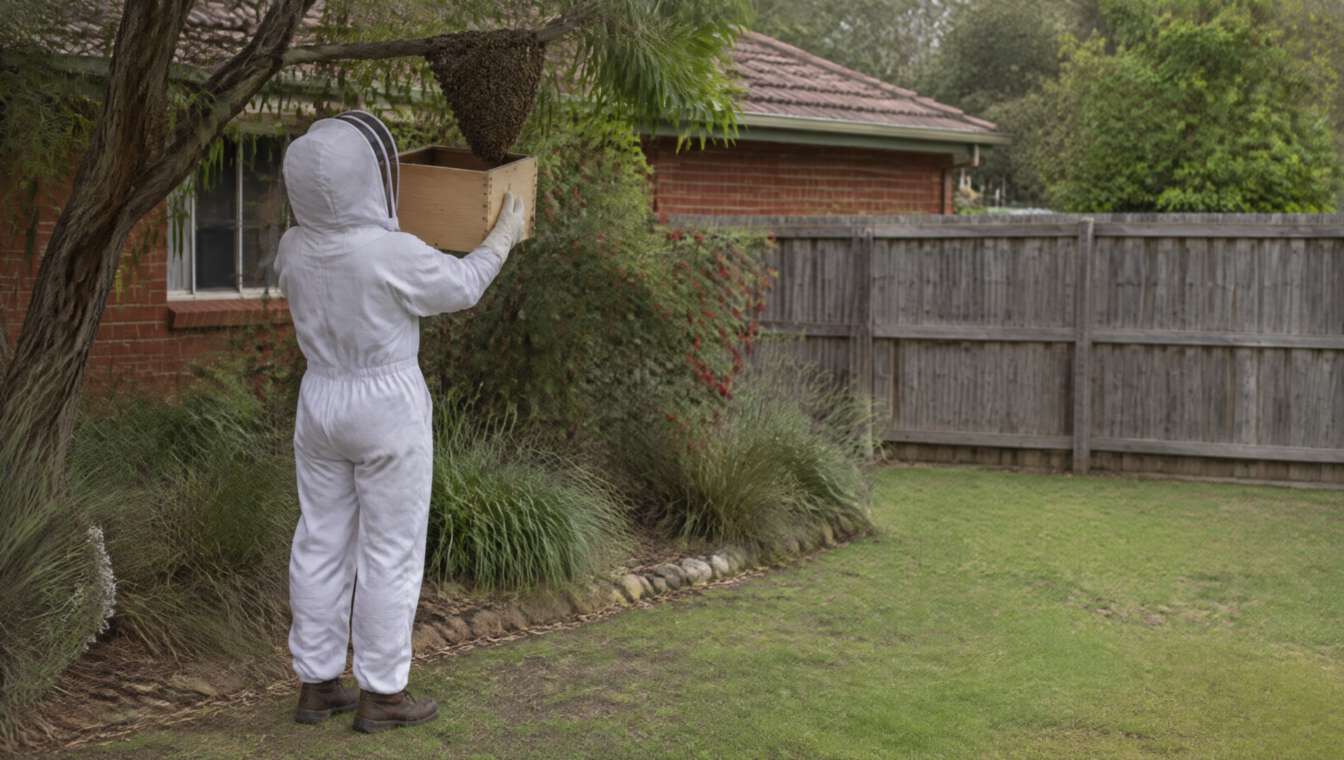
Under Victoria's Livestock Disease Control Act 1994, anyone keeping even one beehive has to register as a beekeeper. A swarm collected by a beekeeper becomes part of a registered apiary.
It might be wasps
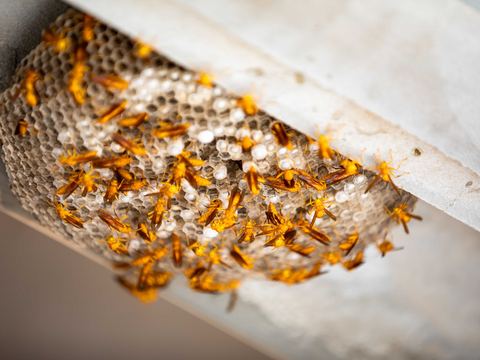
Victoria's Department of Health says the European wasp nests that aren't in the ground are mostly inside buildings, in roof spaces and wall cavities. So a busy gap in a Melbourne wall isn't always bees: check the shape and colour of what's flying before you call.
Swarm or colony?
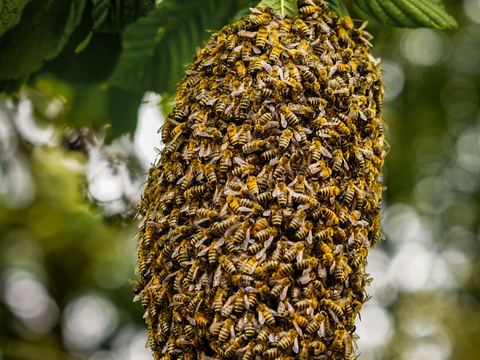
A swarm is a round or oval cluster of bees, with a queen in the middle, resting while scouts look for a new nest. Business Queensland notes that swarming bees are usually placid and unlikely to sting if they're left alone. It's a stopover, not a home.
A colony is bees that have already moved in. You'll see a steady stream flying in and out of one gap in a wall, under the eaves or around a chimney, day after day, and you may hear a hum through the plaster. There's comb inside, and that's a different job.
Bee or wasp?
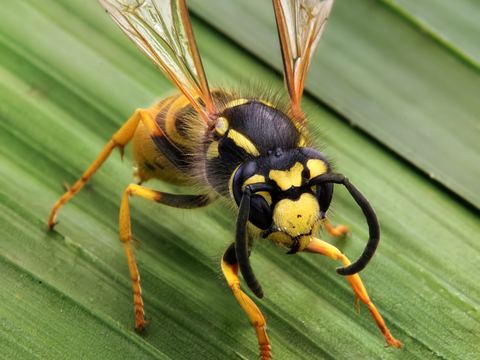
Victoria's Department of Health describes bees as rounder and usually hairy, feeding on pollen and nectar, while wasps are slender and smooth. European wasps are bright yellow and black with all black antennae, and they nest in the ground or in wall and roof cavities too. If the insects are shiny and wasp-shaped, see our Melbourne wasp page instead.
When bees have moved into the house
A pest business will look at where the colony is, how big it seems and how they'll reach it. Ask whether a beekeeper could take the colony out alive first, and if not, what the plan is for the comb and honey left inside the wall or roof.
If the job does need a treatment, the technician will tell you how long to keep people and pets away, and whether the gap gets sealed afterwards so another swarm doesn't move in next spring.
What to do while you wait
You can
- Keep children and pets inside or well away, and close nearby windows.
- Note the exact gap the bees use and the time of day they're busiest.
- Take a photo from well back.
- Don't block, spray or smoke the gap; leave the bees for whoever comes out.
Leave to a pest business
- Taking out or treating a colony in a wall, roof or chimney.
- Any work at height or near power lines.
- Sealing the entry once the bees are gone.
Worth asking
- Could a beekeeper collect this colony instead?
- What happens to the comb and honey inside the wall?
- How long should we keep the area clear afterwards?
- Will you seal the gap so bees don't come back?

Where we'd start with bee removal in Melbourne
For a swarm on a branch or fence, we'd ring a local beekeeper and leave the bees in peace meanwhile. For bees going into the house, we'd keep everyone back and tap Bees with where the gap is.
Want someone to look at it?
Tell us what you've seen and your postcode, and a local pest business that handles exactly that calls you to talk it through.