Bait, bites and kids
If a child might have swallowed rat bait, call the Poisons Information Centre on 13 11 26 straight away, any time, without waiting for symptoms. If a pet ate it, ring the vet now. After a rat bite, NSW Health says to wash the wound with soap and water, dry it, put on antibiotic cream and a clean bandage, and get medical attention.
Rat droppings and the other signs
Rockhampton Regional Council describes rat droppings as black, torpedo shaped and 10 to 18 mm long. Victoria's Health department adds a finer point: Norway rat droppings are banana or sausage shaped, roof rat droppings are spindle shaped, pointed at the ends.
Listen at night for scratching, squeaking, clawing and gnawing. Look for greasy rub marks along walls and beams where rats travel the same route over and over, gnawed woodwork, cables and food containers, crumbs left where they've eaten, and holes about 80 mm across. Nests are made of shredded cardboard, paper, straw or rags, tucked out of sight.
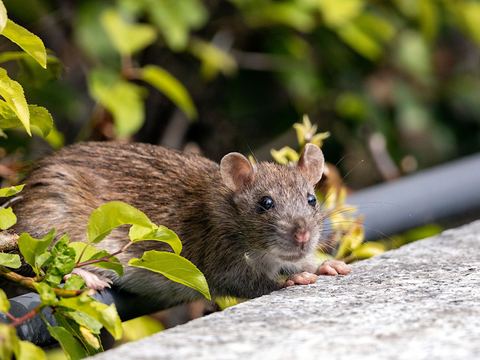
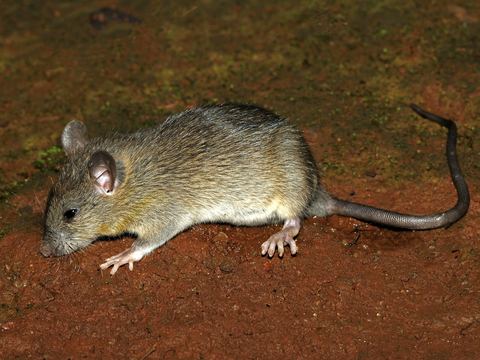
Which rat is it?
| Roof rat (black rat) | Norway rat (brown rat) | |
|---|---|---|
| Build | Slender, pointed nose | Heavier, blunt muzzle |
| Ears | Large and thin, 20 mm or more | Short and thick |
| Tail | Much longer than head and body | Shorter than the body |
| Colour | Charcoal grey to black or light brown, pale belly | Grey-brown, shaggy fur |
| Droppings | Spindle shaped | Banana or sausage shaped |
| Where it lives | Roofs, cavity walls, trees | Burrows, under bushes, sewers |
Why the roof?
The roof rat earns its name. The Australian Museum calls black rats very agile climbers, living in roofs, cavity walls and trees, and Victoria's Health department says they nest in buildings and roof voids. They're mostly out at night but are often seen by day too.
Norway rats stay low: under bushes, in sewers and in deep burrows dug along walls and under buildings. A rat seen running along the fence top is more likely a roof rat; one coming out of a hole by the shed is more likely a Norway rat.
That dead rat smell
A strong smell that turns up suddenly, sometimes with flies gathering at one spot on a wall or ceiling, can mean a rat has died somewhere out of reach. If it can be found, removing it ends the smell; if it can't, the smell fades as the body dries out, though that takes a while. Tell the pest business if anyone has already put bait down.
Why it's worth sorting quickly
Rats breed fast. Victoria's Health department says Norway rats can have 5 to 6 litters a year of 8 to 10 pups, and roof rats 4 to 5 litters of 6 to 8. They also carry disease: NSW Health says leptospirosis bacteria can be in rat urine and get in through cuts, and rat bite fever can come from a bite or from food or water a rodent has fouled.
Your part, and theirs
You can
- Keep food, pet food and birdseed in sealed, chew proof containers.
- Use bins with tight lids and pick up fallen fruit.
- Cut back branches and vines that reach the roof or gutters.
- Clear stacked timber, boxes and junk from against the house.
- Wear gloves when cleaning up droppings, and wash your hands well afterwards.
Leave to a pest business
- Rats in the roof void, walls or subfloor.
- Bait stations (locked boxes that hold rodent bait) placed where children and pets can't reach.
- Finding and proofing the gaps they use to get in.
A good rodent job covers
- An inspection of the roof space, subfloor and outside walls before anything is laid.
- A written note of what was used, where each station sits and how often it's checked.
- The entry points found, with proofing quoted separately if it's extra.
- A follow-up visit to check activity and remove anything no longer needed.

Where we'd start with rats
We'd tidy up the food and the climbing routes this weekend, note where the droppings are, and tap Rats or mice. A rat in the roof usually means a gap in the house, and finding that gap is the part that stops the next one.
Want someone to look at it?
Tell us what you've seen and your postcode, and a local pest business that handles exactly that calls you to talk it through.