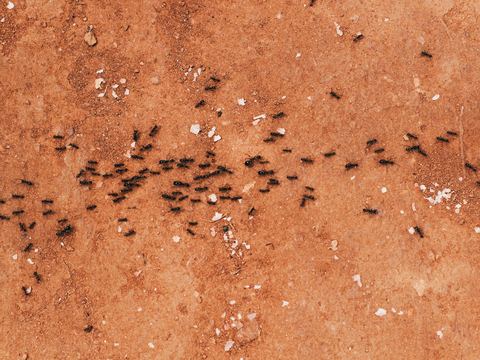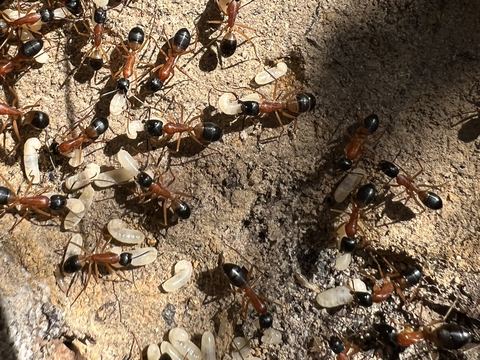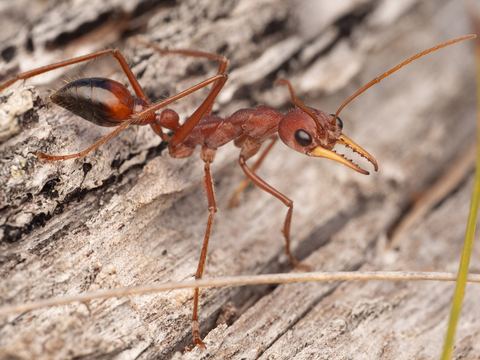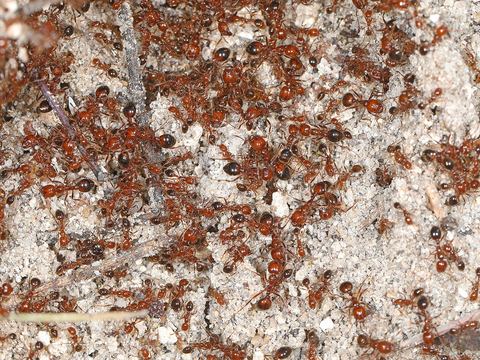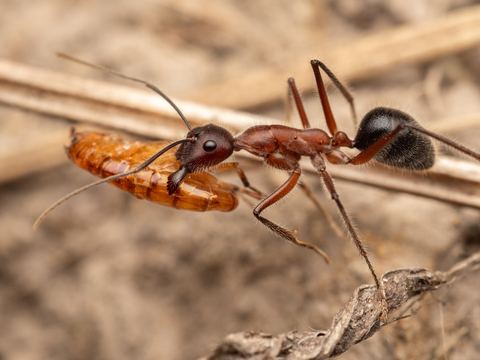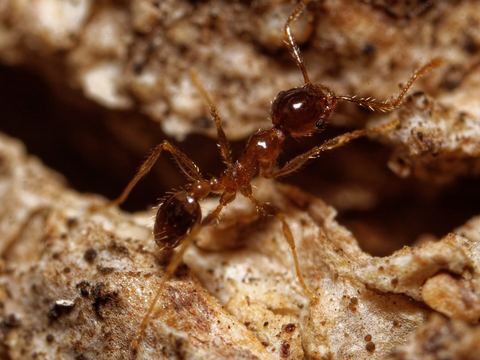
Could they be fire ants?
Report suspected fire ants before anything else: to Biosecurity Queensland, online or by phone, and in NSW to the DPI hotline. Don't disturb the mound or treat it yourself. If anyone has trouble breathing after an ant sting, use their adrenaline autoinjector if they carry one and call 000.
Why the species matters
Australia has more than 4000 known ant species, and Victoria's Health department says only a handful are pests, most of them introduced. Each pest ant nests, feeds and reacts to treatment differently. Pharaoh's ants, for example, shouldn't be sprayed at all: spraying splits the colony into new ones and tends to make things worse.
Get a clear photo, side on, next to something for scale. Then match it against the four below.
The four you're most likely to meet
| Size and look | The giveaway | |
|---|---|---|
| Coastal brown ant | Workers 1.5 to 3 mm, shiny light to dark brown; soldiers 3.5 to 4.5 mm with big heads | Lines of small holes and soil mounds in lawns and between pavers |
| White-footed house ant | Shiny black, 2.8 to 3.5 mm; the pale feet only show under a microscope | Trails to food at night, nests behind cupboards and skirtings |
| Black house ant | Intensely black, 2.5 to 3 mm, sometimes a purplish-green sheen | A strong smell when crushed |
| Argentine ant | Slender and brown, 1.5 to 3 mm | No smell when crushed; slow trails three or more ants wide |
Coastal brown ants
These are the ones lifting sand between pavers. In Western Australia, DPIRD says their nests show as lines of joined up holes and small mounds of soil in lawns and brick paving. Soldiers have large heads and strong jaws, and Victoria's Health department says the sting is relatively painless.
White-footed and black house ants
Both are small, shiny and black, so tell them apart by habit. White-footed house ants slip in through tiny cracks, run trails to food mostly at night, and may nest in wall cavities, behind cupboards and under skirting boards.
Black house ants nest outside along paths and rockeries, and commonly inside ceilings, cavity walls and subfloors too. Crush one on a tissue: if it smells strongly, it's probably a black house ant.
Argentine ants
DPIRD calls the Argentine ant the hardest common pest ant to control in WA, because it moves back into treated areas so quickly. Victoria's Health department says it can recolonise a treated yard from next door within two weeks. They usually nest outside and come in during wet weather, marching up tree trunks to feed on honeydew.
Ants near power points
Singapore ants can nest in power sockets and chew wiring, and Victoria's Health department says they've caused electrical fires. According to DPIRD they're established in Western Australia, New South Wales, Queensland, Victoria and the Northern Territory. Ants pouring out of a power point or switch is a job for an electrician and a pest business, not a can of spray.
Before anyone treats
You can
- Wipe trails with warm soapy water to clear the scent the ants follow.
- Keep sweet food, honey and pet food in sealed containers.
- Fix dripping taps and leaks under the sink.
- Seal the cracks where a trail enters, once you've found it.
- Hold off spraying until you know the species.
Leave to a pest business
- Ants coming back within days of a clean-up.
- Nests inside walls, ceilings or the subfloor.
- Anything to do with power points or wiring.
- Lawns pocked with coastal brown ant holes.
Worth asking the pest business
- Which ant do you think this is, and why?
- Will you use bait, a spray, or both, and where?
- What's the product's full name, and how long should pets keep off treated areas?
- What should I stop doing while a bait is working?
- What happens if they're back in a few weeks?

What we'd do about the ants in the house
We'd wipe the trail, seal the food and watch for a few days. Ants that keep coming back, or that are nesting inside the walls, deserve a pest business: tap Spiders or ants and say which of the four you think it is.
Want someone to look at it?
Tell us what you've seen and your postcode, and a local pest business that handles exactly that calls you to talk it through.