Think you've found fire ants?
Keep people and pets away and leave the nest alone. Don't dig it, spray it or try to catch the ants: they move fast, and large numbers can be on you before you notice. If someone stung has trouble breathing, a swollen tongue or throat, or collapses, use their adrenaline autoinjector if they have one and call 000. For other stings, healthdirect says to take out any visible stinger with something firm like a bank card, wash with soap and water, and apply a wrapped ice pack for 15 minutes.
How to report fire ants
In Queensland
Report to Biosecurity Queensland, online or by phone. Gympie Regional Council says Queenslanders are legally required to report suspected fire ants within 24 hours of finding them.
In New South Wales
Contact the NSW Biosecurity Helpline straight away, or use the NSW Government's online form.
Anywhere else
Contact your state or territory agriculture department and tell them what you've seen.
Take a photo from a distance
NSW Government advice is to take a clear photo or video for identification, and to leave the ants alone.
Don't move anything
Soil, mulch, hay, turf, manure and potted plants can all carry fire ants, so keep them where they are until you've spoken to the report line.
What fire ants look like
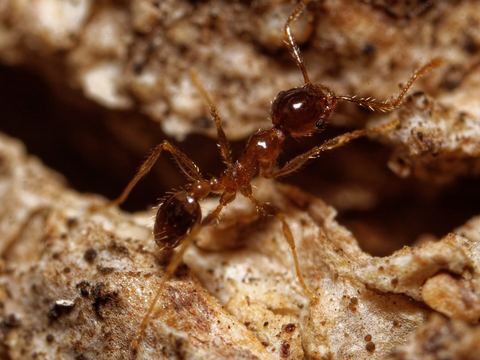
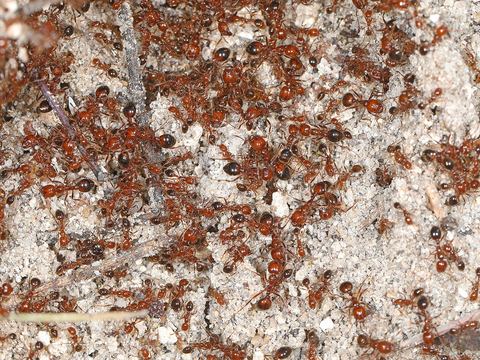
Fire ants are 2 to 6 mm long, and one nest holds ants of various sizes. The head and body are coppery brown, with a darker abdomen.
The nest is often the better clue. Business Queensland says mounds can be up to 40 cm high, or flat like small patches of disturbed soil, with no obvious entry or exit holes. Tweed Shire Council describes loose, crumbly or fluffy looking soil with a honeycomb appearance. Look in open areas such as lawns, pastures and roadsides, and beside or under logs, rocks, pavers and bricks.
Why it's a report, never a job
Fire ants are category 1 restricted matter under Queensland's Biosecurity Act 2014 and prohibited under the NSW Biosecurity Act 2015. Biosecurity zones limit what can be moved, and NSW advice is not to destroy, treat or capture suspected fire ants, so the first call belongs to the authorities.
That's why our form never takes a fire ant job. On Queensland postcodes it points you to the report line instead. If the report comes back as ordinary ants, our ant control page is the place to go next.
Where fire ants have been found
They were first detected in the Brisbane area in February 2001, and nests have since been found across an estimated 600,000 hectares of South East Queensland. In NSW, three nests were confirmed at South Murwillumbah in November 2023, 13 km south of the Queensland border, and Tweed Shire Council says a NSW Biosecurity (Fire Ant) Emergency Order is in place. In October 2026 the NSW Government reported a nest at the Enfield Intermodal Logistics Centre in Sydney's inner west, likely arrived from overseas by container.
Zones change, so we don't say whether any suburb is in or out. The report line can tell you what applies at your address.
What a sting does
Fire ants both bite and sting, and they can sting repeatedly. Business Queensland says stings cause a painful, burning, itching feeling lasting up to 1 hour, and small pustules may form at the sting sites hours later. In rare cases they cause a severe allergic reaction.
They also go for young animals, stinging around the eyes, mouth and nose, which is why pets and livestock need keeping well away from a nest.

What we'd do about fire ants
We'd keep everyone back, take one clear photo from a distance, and make the report call the same day. Even if you're not sure, the report comes first. We won't pass on a fire ant job, and no one should treat a suspected nest before the report line has heard about it.
Want someone to look at it?
Tell us what you've seen and your postcode, and a local pest business that handles exactly that calls you to talk it through.