If someone is stung
Move everyone away from the bees, and don't spray, hose or block the gap. Scrape the sting out with a fingernail or the edge of a card; pulling it can squeeze the venom sac. Noisy breathing, a swollen tongue or throat, wheezing, dizziness or collapse: use their adrenaline autoinjector if they carry one, then call 000.
Is it a swarm or a colony?
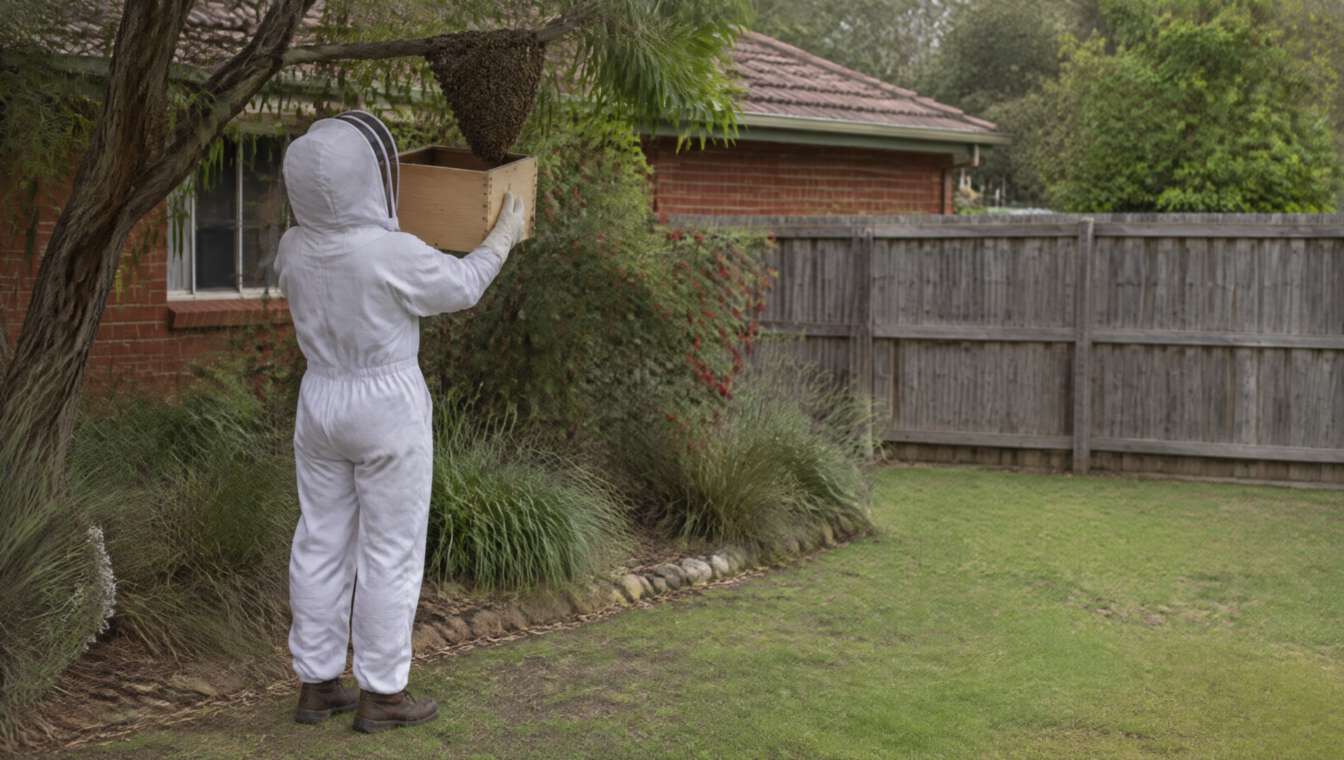
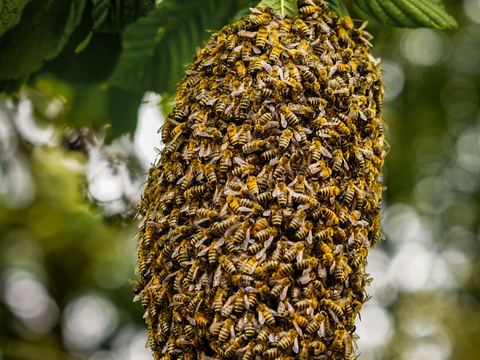
A swarm is honey bees between homes. Business Queensland describes it as a round or oval mass of bees, clustered around a queen while they look for somewhere to start a new nest. You'll see it hanging from a branch, a fence post, a letterbox or the side of a wall, with bees on the outside of the clump rather than going into anything.
A colony has already moved in. The giveaway is traffic: a steady line of bees going in and out of the same gap, day after day. Common entry points are a gap under the roof sheeting or tiles, a wall vent, a weep hole, the chimney or a crack beside a window frame. On a quiet day you may hear a hum through the plaster.
Business Queensland says swarming bees are usually placid and unlikely to sting if they're left alone, and that swarms happen naturally in spring to early summer in Queensland. A colony guarding comb inside your wall is a different animal: leave its entrance well alone.
Swarm or bees in the house: who to call
| A swarm | Bees living in the house | |
|---|---|---|
| What you see | A hanging clump of bees on a branch, fence or wall | Bees going in and out of one gap in the building |
| Who to call | A local beekeeper or beekeeping club | A pest business, which may work with a beekeeper |
| What our form does | Shows that a local beekeeper may be able to collect it, and sends no job | Sends the job, marked urgent for the pest business |
Why a beekeeper comes first for a swarm
Honey bees matter. Business Queensland points out that European honey bees and native bees are important for pollination and honey production, and it suggests ringing your local beekeeping club for advice about a swarm. Victoria's Health department goes further and tells pest control operators to refer bee enquiries to a beekeeper or the Victorian Apiarists Association.
That's why our form doesn't pass on a swarm. Tap Bees, say the bees are clustered outside, and it shows you the beekeeper option instead of sending your details to a pest business.
In Queensland, report Asian honey bees
Asian honey bees are about 10 mm long: smaller and less hairy than European honey bees, with stronger black or brown and yellow stripes. Business Queensland says they're found around Cairns, from Cape Tribulation to Cardwell, with the known area extended to Cooktown and Rossville in September 2025, and some reported in south western Brisbane in June 2026 were being investigated.
Every sighting must be reported to Biosecurity Queensland within 24 hours. Report them before you ring anyone about a treatment. In Queensland they've been found nesting in tree hollows, under eaves, in walls and under floorboards, the same places an ordinary colony uses.
What the job involves when bees live in the house
It starts with a look at the entrance and a guess at where the comb sits: just inside a wall vent, or a metre along the ceiling. Some colonies can be collected alive with their comb, which usually means lifting roof sheets or opening a section of wall or ceiling. Others are treated through the entrance where opening up isn't practical. Ask which approach the business takes, and why, before they start.
Whatever happens to the bees, two things finish the job properly: getting the comb and honey out, since a wall full of wax and honey can draw in other insects, and closing the entry once the colony is gone so a new swarm doesn't move into the same space.
What makes the job bigger or smaller
Height and access matter most: a colony behind a ground floor vent is a different job from one under the tiles of a double storey roof or inside a chimney. So does age, because a colony that's been there for seasons has far more comb. Opening a wall or ceiling means someone has to patch it afterwards, so ask whether that's included or whether you'll need a plasterer or carpenter.
Your part, and theirs
You can
- Keep children and pets inside or well away until it's sorted.
- Close windows and doors on the side of the house with the bees.
- Watch where the bees go in, from a distance, and take one photo from well back.
- For a swarm, leave it alone and ring a local beekeeping club.
Leave to a pest business
- Opening roofs, walls or ceilings to reach a colony.
- Anything at height, on a roof or inside a chimney.
- Taking out the comb, and closing the entry once the bees have gone.
Before you say yes
- Will you try to collect the bees alive, or work with a beekeeper who can?
- Will the comb and honey come out, and who patches the wall or ceiling afterwards?
- How will you close the entry so another swarm doesn't settle there?
- If you use a product, what's its full name, and how long should we stay clear of that side of the house?

Our take on bee hive removal
If it's a swarm on the fence, we'd bring everyone inside, leave the bees alone and ring a local beekeeping club. If bees are going into the house itself, tap Bees, say where the gap is, and the job goes through marked urgent.
Want someone to look at it?
Tell us what you've seen and your postcode, and a local pest business that handles exactly that calls you to talk it through.