Keep well back
Don't spray, hose or knock any nest. If a child has 5 or more stings or an adult 10 or more, healthdirect says to see a doctor straight away. For trouble breathing, swelling of the face or throat, or collapse after a sting, call 000.
Read the nest
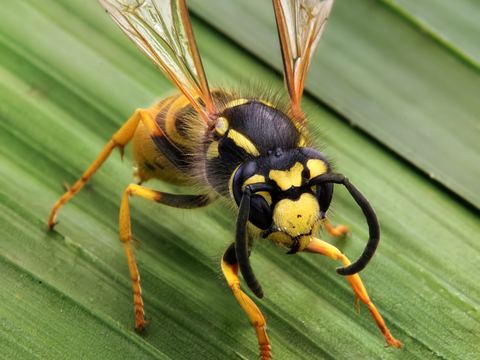
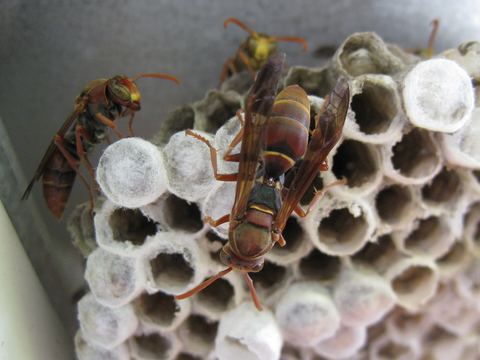
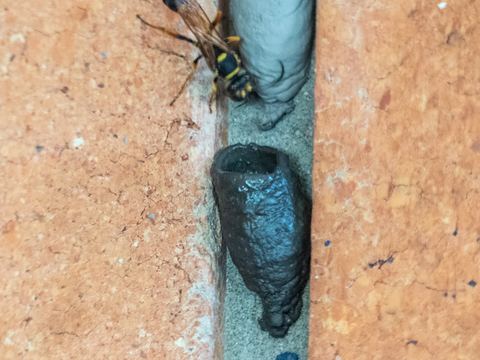
| Paper wasp | European wasp | Mud-dauber | |
|---|---|---|---|
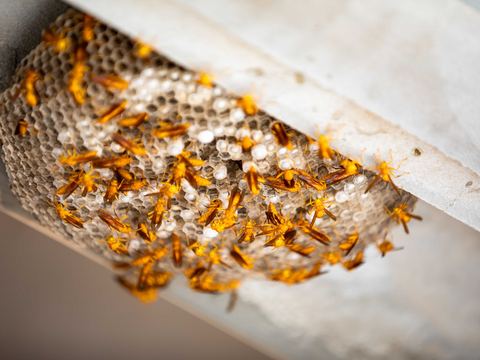
| The nest | Upside down cone of open hexagonal cells | Papery nest you rarely see | Made of mud |
| Where | Under eaves, pergolas and branches | In the ground, a wall cavity or roof | Sheltered spots on houses, sheds and rock overhangs |
| Nest size | Golf ball to side plate | Can reach basketball size or bigger | Look for the wasps at mud and water |
| The wasp | Slender, narrow waist, back legs dangle | Stout, yellow and black, legs tucked in | About 3 cm long |
| Temper | Stings if the nest is disturbed | Attacks if disturbed, can sting more than once | Can sting, but attacks are rare |
Paper wasps
The wasp most people meet at the back door. The Australian Museum describes a slender body with a very narrow waist, a mostly black abdomen with yellow or orange bands and brown-tinted wings, about 2.2 cm long. They hang around shrubs, lawns and water with their back legs dangling.
Paper wasps aren't as aggressive as European wasps, but they will defend the comb, and several stings at once can cause a more serious reaction. Victoria's Health department says they shouldn't be left to nest in or near the home. Away from the house, native paper wasps are useful: they feed caterpillars to their young.
European wasps
Yellow and black, stout and fast, and you'll usually see the traffic before the nest. Most nests are underground or inside a wall or roof. They're the wasp that turns up at picnics, and the one Western Australia asks people to report. Our European wasp page covers how to pick one and the WA report line.
Mud-daubers
About 3 cm long and often seen collecting water and mud. They build mud nests in protected spots on houses and sheds, then stock them with spiders they've stung and paralysed, as food for their young. The Australian Museum says they can sting painfully, but attacks are rare.
Is it a wasp or a bee?
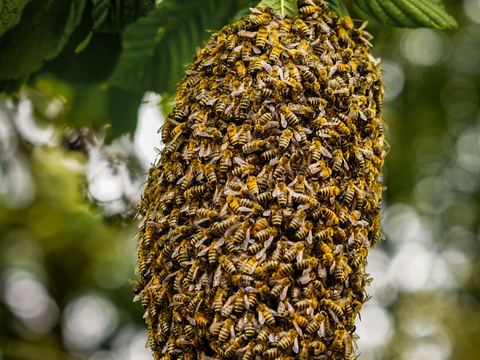
Bees are rounder and usually hairy, and feed on pollen and nectar. Wasps are usually slender and smooth. A cluster of bees hanging off a branch is a swarm, which is usually a beekeeper's job: see bee swarms. Bees flying in and out of a gap in the wall are on our bees page.
Getting rid of wasps around the yard
You can
- Keep food, drinks and meat scraps covered outdoors, and bins closed.
- Look under the eaves, the pergola and the shed roof now and then, so you spot a comb while it's small.
- Keep children and pets away from a nest you've found.
- Take a photo from a distance so the pest business knows what it's dealing with.
Leave to a pest business
- Paper wasp nests near doors, windows, washing lines and play areas.
- Any nest you can't see the whole of: in the ground, a wall or the roof.
- Nests up a ladder. Wasps and ladders don't mix.

Where we'd start with wasps and wasp nests
A mud-dauber nest on the garage wall usually isn't worth a treatment. A paper wasp comb over the back door is, and so is anything that looks like a European wasp nest. We'd keep everyone well back and tap A wasp nest; in WA, a European wasp nest gets reported to the state first.
Want someone to look at it?
Tell us what you've seen and your postcode, and a local pest business that handles exactly that calls you to talk it through.