If someone is stung
Call 000 if they have noisy breathing, a swollen tongue or throat, a wheeze or persistent cough, a change in voice, dizziness or collapse, and use their adrenaline autoinjector straight away if they carry one. For an ordinary sting, healthdirect says to wash it with soap and water and hold an ice pack wrapped in cloth on it for 15 minutes. Wasps can sting more than once, so move away from the nest first.
How to identify a paper wasp
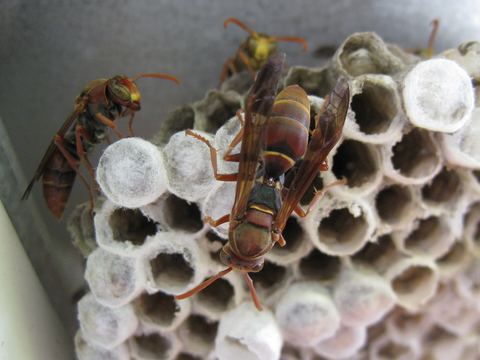
Think long and thin. The Australian Museum describes a slender body with a very narrow waist, a mainly black abdomen with a few yellow or orange bands, and brown-tinted wings, at about 2.2 cm long.
The way it flies helps too. Victoria's Health department says paper wasps let their back legs dangle in flight and often hover around bushes, over lawns and near water, which is a lazier, drifting flight than a European wasp's.
It's probably a paper wasp if
- The antennae are orange-brown rather than all black.
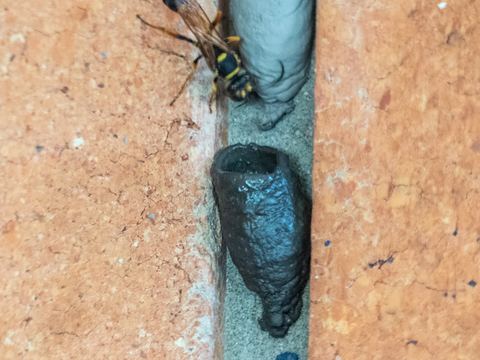
- You can see the whole nest, and it's an open comb of cells rather than a hole with wasps streaming in and out.
- The comb is somewhere between golf ball and side plate size.
- It's hanging above ground, under a branch, the eaves or a pergola beam.
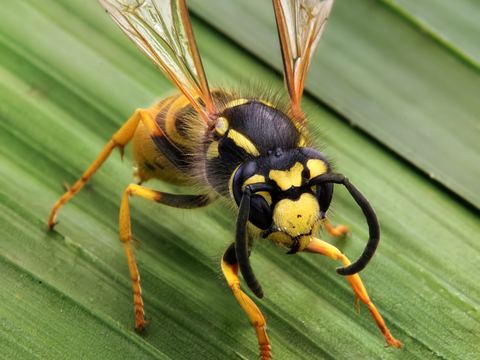
- One caution: the native yellow paper wasp is close to a European wasp in size and is often mistaken for one, so check the antennae and the nest, not just the colour.
Where the comb hangs
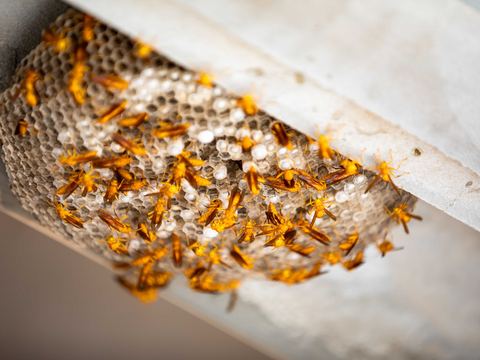
Paper wasp nests are shaped like an upside down cone of hexagonal cells, built under tree branches and the eaves of houses. Because they're usually above ground and open, you can often see the wasps sitting on the cells.
In Canberra, the ACT Government says Asian paper wasps build on man-made structures and also hide nests in trees and bushes, and often sting people who disturb them. So check a shrub before you prune it, as well as the eaves.
Useful in the garden, unwelcome at the door
Paper wasps do some good. Victoria's Health department says native paper wasps feed on nectar and feed caterpillars to their larvae, which helps keep garden pests down. The Australian Museum says they're not as aggressive as European wasps and normally attack only when their nest is disturbed.
The same health department also says paper wasps shouldn't be allowed to nest in or near the home, because they may attack if the nest feels threatened, and the museum warns that several stings at once can bring a more severe reaction. Both points stand: a comb at the back fence can usually stay, while one over a doorway can't.
In Western Australia
WA reports European wasps to its primary industries department, because it's working to stop them becoming established. Paper wasps are different: they're a normal pest job in WA as everywhere else, and the wasp option in our form shows the European wasp report line and still takes paper wasp jobs.
While you decide what to do
You can
- Mark the spot and keep children and pets well clear of it.
- Close the windows and doors closest to the comb.
- Photograph the comb from a distance, with something nearby for scale.
- Check shrubs by paths and the clothesline before you prune or hang washing.
Leave to a pest business
- Treating or taking down any comb, whatever its size.
- Combs above doorways, at height or deep inside a dense shrub.
- Any nest near someone who has reacted badly to a sting before.

Where we'd start with the paper wasp
A paper wasp comb at the back fence, away from paths, we'd probably leave: those wasps are feeding caterpillars to their young, and they sting when the nest is threatened rather than at random. One by a door, a window or the play area is a different matter. Keep everyone back and tap A wasp nest.
Want someone to look at it?
Tell us what you've seen and your postcode, and a local pest business that handles exactly that calls you to talk it through.