Stings first, then the nest
Call 000 if someone stung has noisy breathing, a swollen tongue or throat, a wheeze or cough that won't stop, a change in voice, dizziness or collapse. If they carry an adrenaline autoinjector, use it straight away, then call. Keep everyone back from the nest: European wasps are more aggressive than bees and can sting more than once.
How to pick a European wasp
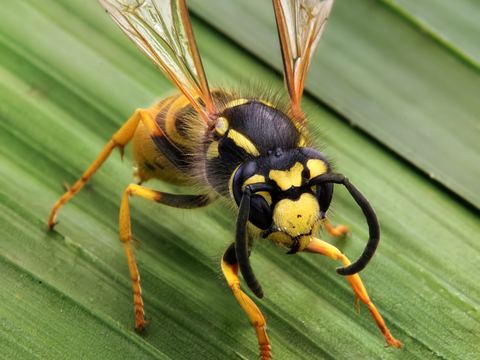
Look for a stout body with a pair of black spots on each yellow band, yellow legs and two long, all black antennae. Most are 1.2 to 1.6 cm long; a queen is about 20 mm.
Watch how it flies. Victoria's Health department says European wasps fly fast with their legs tucked against the body and generally don't hover. Paper wasps let their back legs dangle and drift around shrubs and lawns.
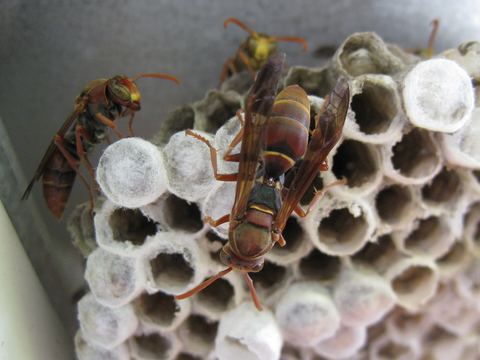
The native yellow paper wasp is about the same size and often mistaken for a European wasp. Its antennae are orange-brown, and its body is longer and thinner.
European wasp or paper wasp?
| European wasp | Paper wasp | |
|---|---|---|
| Body | Stout, black spots on yellow bands | Slender, very narrow waist |
| Antennae | All black | Orange-brown |
| In flight | Fast, legs tucked in, rarely hovers | Back legs dangling, often hovers |
| Nest | Hidden: ground, wall cavity or roof | Open grey comb under eaves or branches |
| Nest size | Can be basketball size or bigger | Golf ball to side plate size |
Finding a European wasp nest
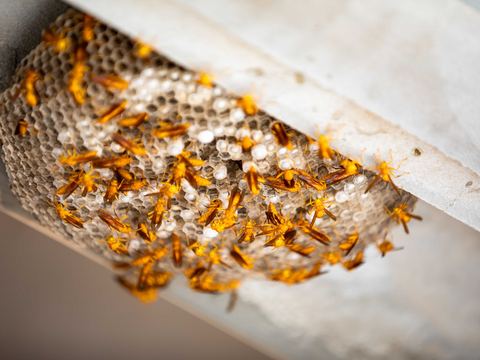
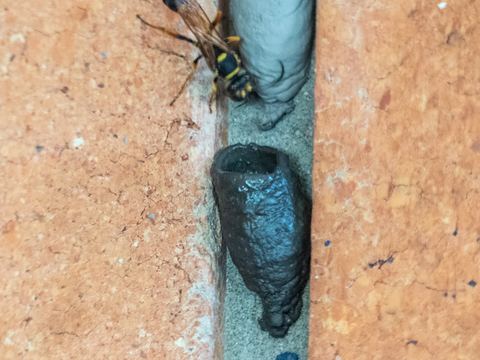
Victoria's Health department says about 80% of nests are in the ground, and most of the rest are inside buildings, in roofs and wall cavities. The nest is made of chewed wood pulp and saliva, so it looks papery. A nest made of mud belongs to a different wasp.
What you'll usually see is traffic: a steady stream of wasps in and out of one hole in the lawn, a gap in the brickwork or a spot under the roofline. Workers forage up to half a kilometre from home, so wasps at your barbecue may be nesting next door.
They're drawn to meat, sweet food and drinks, which is why they find the barbecue and the bins.
When they're worst
A queen starts each colony in spring, the nest grows all summer, and new queens and males hatch in autumn. That's why late summer and autumn bring the most wasps: Biosecurity Tasmania says they're most troublesome in autumn, and in 2021 the ACT Government said peak season ran until May.
In a warm climate a nest can survive winter and keep growing. The Australian Museum says those nests can pass 100,000 wasps.
In Western Australia, report it
WA is keeping European wasps from settling in, and DPIRD's advice is to report a nest rather than treat it. Contact its Pest and Disease Information Service, or use the MyPestGuide Reporter app. In the 2025 to 2026 season the program found 73 nests at 25 locations, 37 of them in Albany, and DPIRD says 90% of the nests it finds are underground.
While you work out where it is
You can
- Cover food and drinks outside, and check a can before you sip.
- Keep bins lidded and pet food inside.
- Watch the flight path from well back to spot the entrance.
- Photograph the entrance from a distance for the pest business.
Leave to a pest business
- Any nest in the ground, a wall or the roof.
- Nests near doors, paths, play areas or a neighbour's fence line.
- Outside WA only: in WA the state deals with it.

What we'd do about the European wasp
Outside WA, we'd keep the kids and dog inside, find the entrance from a safe distance and tap A wasp nest with where it is. Don't pour anything down the hole or block it: DPIRD warns that disturbing a busy nest can lead to thousands of painful stings. In WA, we'd call DPIRD instead.
Want someone to look at it?
Tell us what you've seen and your postcode, and a local pest business that handles exactly that calls you to talk it through.