Stings are rare, but
Mud-dauber wasps can give a painful sting, though the Australian Museum says attacks are rare. As with any wasp, if someone stung has trouble breathing or swelling of the face or throat, call 000, and use their adrenaline autoinjector straight away if they have one.
How to recognise a mud dauber
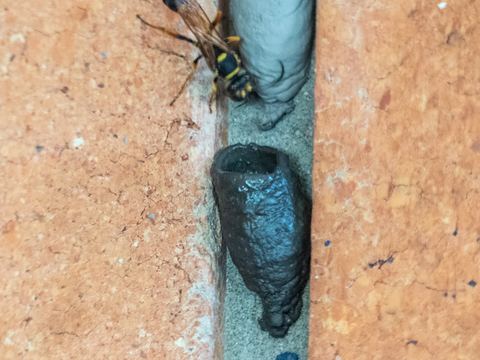
The Australian Museum gives the mud-dauber wasp's size as 3 cm, and the City of Adelaide notes they're larger than European wasps. You'll usually notice one at work: they're often seen collecting water and mud, at the edge of a puddle, a dripping tap or a garden bed.
Then you find the nest. Mud daubers build their nests out of mud in protected parts of houses and buildings, and on rock overhangs in the bush. Around a house, that means anywhere sheltered from the rain, such as the eaves, a carport or the inside of a shed.
What's inside the mud
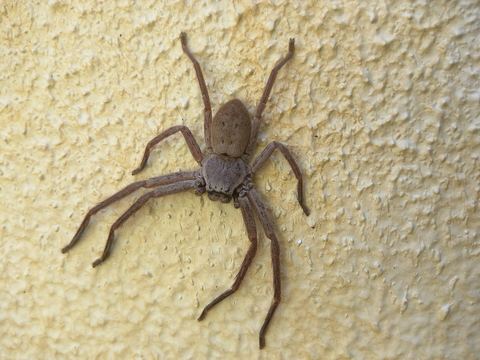
Spiders. A mud dauber stings and paralyses spiders, then seals them into the mud cells as food for its young. So the lump on the pergola is a larder for the next generation of wasps, and it's taking spiders out of your garden as it goes.
Mud nest or paper nest?
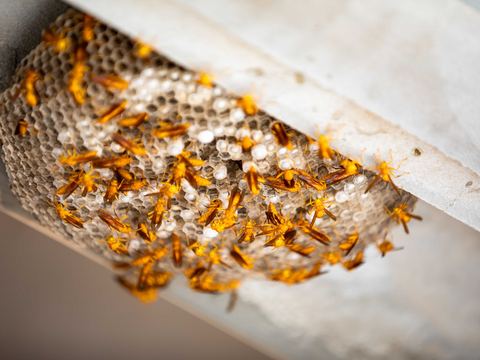
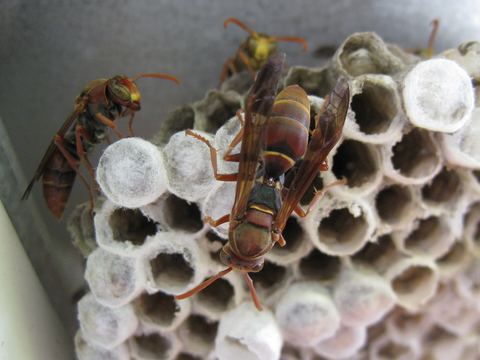
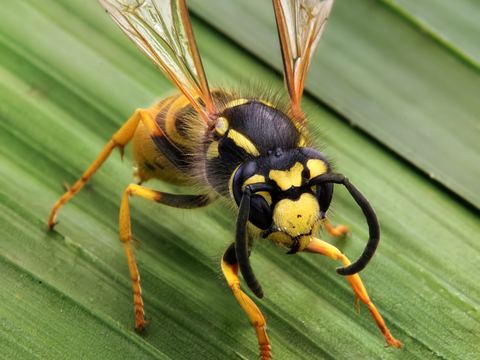
| Mud dauber | Paper wasp | European wasp | |
|---|---|---|---|
| Nest material | Mud | Open cells you can see into | Chewed wood pulp, papery, usually out of sight |
| Usual spot | Sheltered corners of houses, sheds, rock overhangs | Hanging under branches and eaves | Mostly underground; some in roofs and walls |
| How likely to sting | Rarely, says the City of Adelaide | When the nest feels threatened | Attacks when the nest is disturbed, and can sting repeatedly |
It isn't a European wasp nest
Victoria's Health department puts it simply: nests made of mud are not European wasp nests. That matters most in Western Australia, where European wasps get reported to the state. A mud nest on a WA house is not one of those.
When is it worth a call?
Mostly it isn't. A mud nest on the eaves, the shed or the back of the garage can be left. Where it's worth asking a pest business is when the nest is somewhere people brush past every day, like a door frame, a letterbox or a gate latch, and wasps are still coming and going. Don't knock it down while it's in use.
What you can do
You can
- Leave nests on eaves, pergolas and sheds alone.
- Fix dripping outdoor taps and puddles by the door, where they gather mud.
- Watch from a distance before deciding: wasps flying in and out mean it's in use.
- Check the letterbox and gate latch before reaching in.
Leave to a pest business
- An active nest over a doorway, in a letterbox, or anywhere people brush past.
- Nests at height that need a ladder.
- Any wasp nest near someone with a known sting allergy.

Our view
Leave them be. A mud dauber is clearing spiders, it rarely stings, and the nest isn't a sign of anything worse. If one is in a spot where someone keeps brushing past it, tap A wasp nest and mention that it's made of mud.
Want someone to look at it?
Tell us what you've seen and your postcode, and a local pest business that handles exactly that calls you to talk it through.