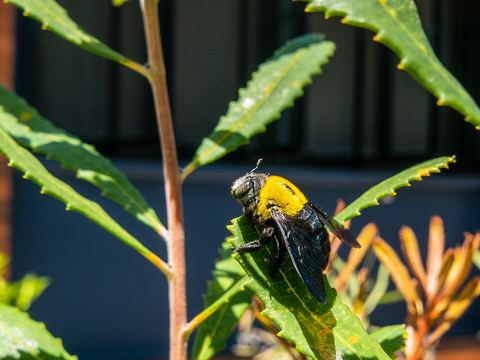
How to recognise a carpenter bee
Size first. The Australian Museum says carpenter bees are some of the largest native Australian bees. The peacock carpenter bee is 1.6 to 1.8 cm long, with bright metallic colours that change with the light: it can look purple, then moments later a yellowy green.
You'll often hear one before you see it. Carpenter bees make a deep droning noise as they fly between flowers, feeding on nectar and pollen.
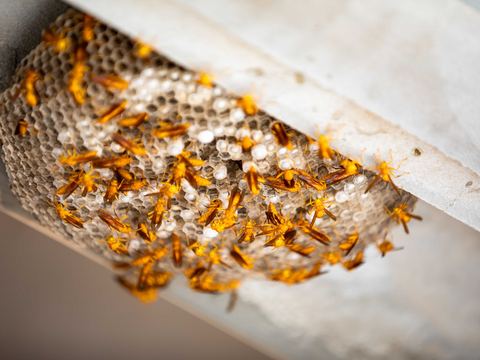
Like other bees, they're rounder and usually hairier than wasps, which tend to be slender and smooth. That's a quick way to sort a big buzzing insect in the garden.
Where they nest
The name comes from the nest. A peacock carpenter bee uses its strong jaws to cut an entrance hole into soft wood, such as a dead banksia, and usually digs a single tunnel about 30 cm long, with side passages if the wood is wide enough.
Inside, each egg is sealed into its own brood cell with a ball of nectar and pollen for the larva to eat. Females sometimes take turns guarding the entrance while the main egg-laying bee is out foraging, so you may see a bee sitting in the hole.
Where you'll find them
The peacock carpenter bee is found in eastern Australia north of Sydney, in urban areas, forests and woodlands, and heath. Our official sources only confirm carpenter bees in New South Wales and Queensland so far, which doesn't mean they're absent elsewhere.
Will it damage the house?
What the Australian Museum describes is soft, dead wood like banksia, not the frame of a house, and we haven't found an official Australian source on carpenter bees in building timber. So a bee hole in an old garden stake or a dead branch is just that.
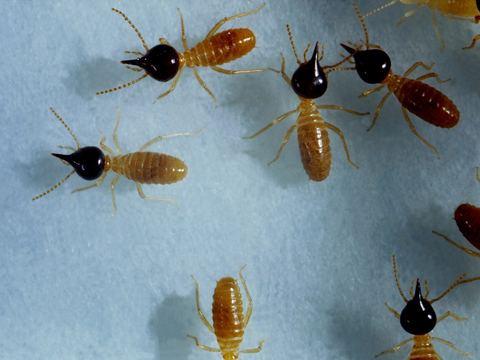
If you're finding holes, crumbling or hollow-sounding timber in the house itself, don't assume it's a bee, and don't break into the wood to look. Have it inspected: termites are the question that matters in house timber.
Do carpenter bees sting?
The official sources we read don't cover carpenter bee stings, so we won't guess. Any bee or wasp sting can cause anaphylaxis: if someone stung has trouble breathing or swelling of the face or throat, use their adrenaline autoinjector straight away and call 000.
Carpenter bee or honey bees?
| Carpenter bee | Honey bees | |
|---|---|---|
| What you see | One big, shiny bee at a hole in soft wood | A cluster of bees, or a stream of them at a gap |
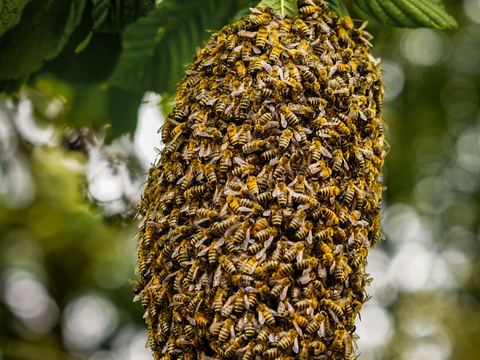
| Swarms? | No: only honey bees swarm | Yes: a round or oval mass looking for a new home |
| Who to call | Usually nobody | A beekeeper for a swarm; a pest business for bees living in a wall or roof |

What we'd tell a friend
Leave it. A carpenter bee in a dead banksia or an old garden stake is a native pollinator at work, and Business Queensland says native bees shouldn't be destroyed because they matter for pollination. If what you've really got is a mass of bees on a branch, that's a bee swarm and a beekeeper's job. Bees going in and out of a wall or roof are a pest job: tap Bees.
Want someone to look at it?
Tell us what you've seen and your postcode, and a local pest business that handles exactly that calls you to talk it through.