Stings, and what not to do
Keep people and pets back, and don't spray the bees or block the gap they're using. For a sting, healthdirect says to get the sting out fast by scraping sideways with a fingernail or card, never pinching it, then wash it and use a wrapped ice pack for 15 minutes. Signs of anaphylaxis mean the adrenaline autoinjector first, then 000.
Bees in Brisbane
Asian honey bees under investigation
Business Queensland says Asian honey bees were reported in south-western Brisbane in June 2026 and were being investigated in July 2026. They're prohibited matter in Queensland, and a suspected sighting must be reported to Biosecurity Queensland within 24 hours.
How to spot one
Asian honey bees are about 10 mm long, smaller and less hairy than European honey bees, with sharp black or brown and yellow stripes. In Queensland they've been found nesting in tree hollows, under eaves, in walls and under floorboards.
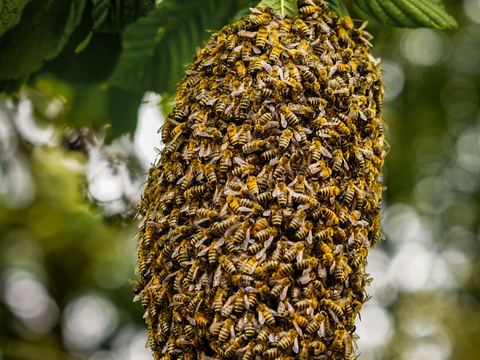
Swarms are usually calm
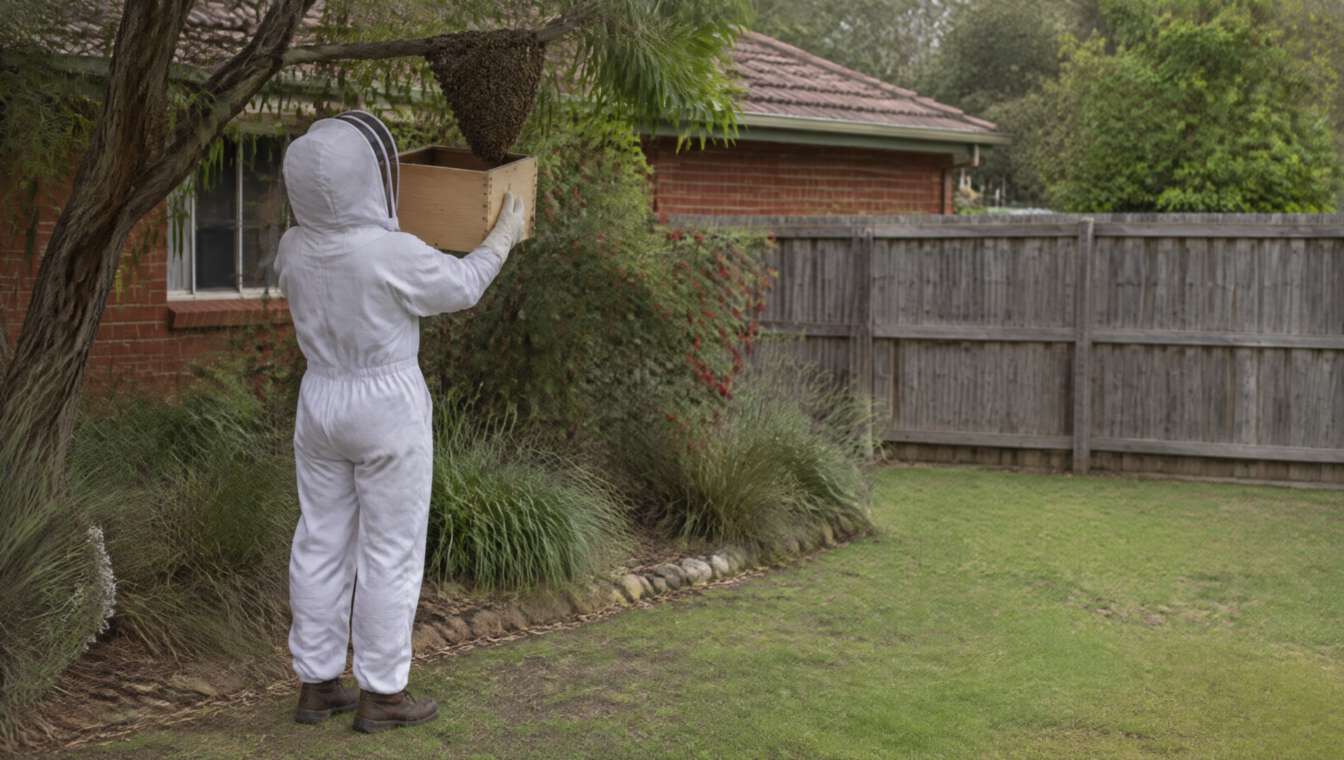
Business Queensland says swarming bees are usually placid and unlikely to sting if they're left alone, and suggests calling a local beekeeping club for advice.
Honey bees aren't for destroying
Business Queensland asks people to confirm which bee it is before doing anything, and says European honey bees and native bees shouldn't be destroyed.
Swarm, hive in the house, or something else?
| Swarm | Bees in a wall or roof | Carpenter bee | |
|---|---|---|---|
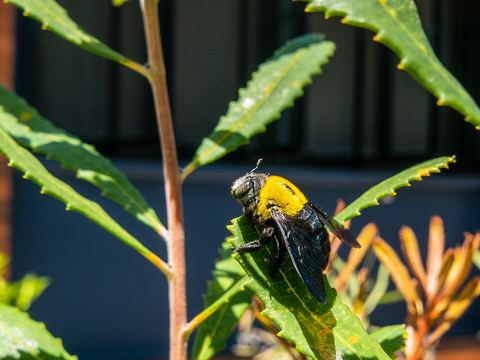
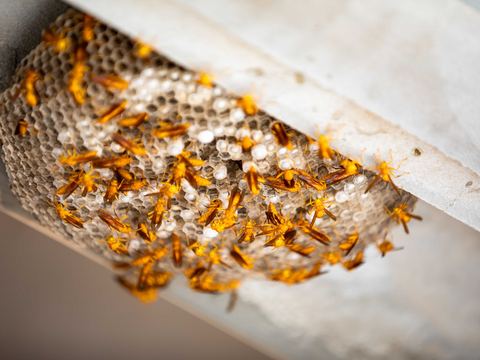
| What you see | A round or oval cluster of bees on a branch, fence or post | A steady line of bees in and out of one gap | One large, glossy bee with metallic colours, droning around soft wood |
| What's happening | The bees are resting while they look for a new home | A colony has moved in and is building comb | A native bee nesting in a single tunnel in dead timber |
| Who to call | A local beekeeper | A pest business, through us | Usually nobody |
When bees in the house are a pest job
Once a colony settles inside a wall cavity, under the floor, in the roof or up a chimney, the bees have to be dealt with where they are, and the comb they've built goes with them. That's work for a pest business, sometimes with a beekeeper alongside.
Because honey bees shouldn't be destroyed if there's another way, ask whether the colony can be taken out alive by a beekeeper the business works with. Where that isn't possible, ask what happens to the comb and honey left inside, and how the gap will be closed so a new swarm doesn't use it.
The job is bigger when the colony is high up, inside a double brick wall, behind tiles or roof sheeting, or has been there long enough to build a lot of comb.
Questions for the pest business
- Are you sure these are European honey bees and not Asian honey bees?
- Can a beekeeper you work with take the colony out alive?
- Will the comb be removed, or left in the wall?
- How will you close the gap afterwards?

If it were our house in Brisbane
A swarm on the fence, we'd leave alone and call a beekeeping club. Bees going in and out of the wall, we'd tap Bees and ask about a live removal. Anything that looks like a small, stripy Asian honey bee, we'd report to Biosecurity Queensland first.
Want someone to look at it?
Tell us what you've seen and your postcode, and a local pest business that handles exactly that calls you to talk it through.