If someone is stung
Signs of anaphylaxis (trouble breathing, a swollen tongue or throat, collapse): use their adrenaline autoinjector straight away if they have one, then call 000. healthdirect says bull ant stings sometimes cause anaphylaxis, and jack jumper stings can too. For an ordinary sting, scrape off any visible stinger with a bank card or fingernail, wash with soap and water, and hold a wrapped ice pack on it for 15 minutes.
How to recognise a bull ant
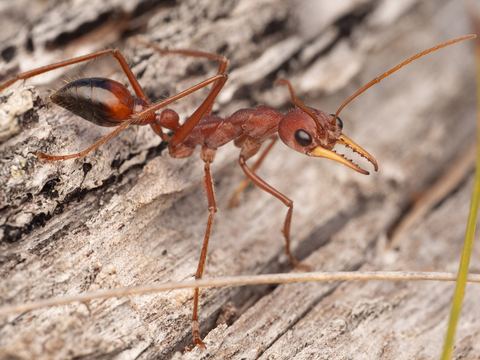
Size is the first clue. Bull ants run from 8 to 40 mm, which makes the big ones the largest ants most people ever see. Many species carry bright red or orange on the head or the rear end, and all of them have long, slender jaws held out in front.
They also watch you. The Australian Museum says bull ants have superior vision and can track an intruder from a metre away, which is why they turn to face you when you lean over the nest.
There are about 90 species in Australia, all in the genus Myrmecia, and they're found throughout the country. Some of the smaller ones are called jumper ants because they leap at intruders; the jack jumper is one of them.
Where the nest is
Usually underground, with an entrance that's small or hidden, often just a hole among leaf litter or at the base of a plant. The Australian Museum says nests can go several metres down, so what you see on the surface is a small part of it.
Bull ants defend the nest against anything that comes too close, whatever its size. So the risky moment is kneeling, sitting or weeding right beside an entrance you hadn't noticed.
Bull ant or something smaller?
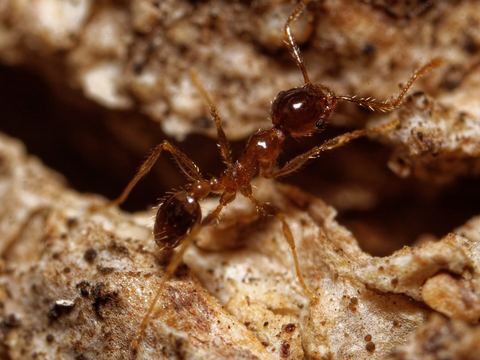
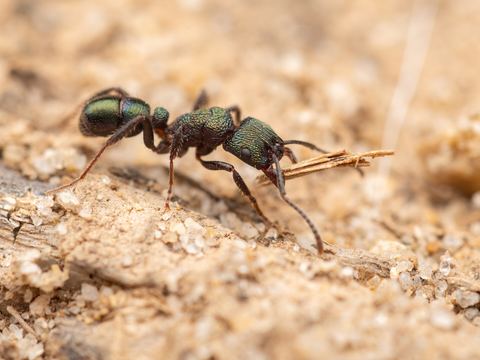
| Bull ant | Banded sugar ant | Green-head ant | |
|---|---|---|---|
| Length | 8 to 40 mm | 5 to 15 mm | 5 to 7 mm |
| Look | Long jaws, often red or orange patches | Orange-brown middle, black head and rear | Metallic green-blue to green-purple sheen |
| Nest | Underground, small hidden entrance | Soil, rotting wood, under rocks | Soil, under twigs or wood, base of shrubs |
| Stings? | Yes, painfully | No, but may bite | Yes |
Living with them
You can
- Wear shoes and gloves when you garden near known nests.
- Mark the entrance with a stake so nobody kneels on it.
- Keep sandpits, play equipment and the clothesline away from nest areas.
- Note where the ants come and go, and photograph one from a safe distance.
Leave to a pest business
- A nest beside a path, a doorway or where children play.
- Any nest when someone in the house has reacted badly to an ant sting before.
- Digging out a nest. Don't try that yourself.

Where we'd start with bull ants
A bull ant nest down the back of a bush block isn't hurting anyone, and we'd leave it alone. One beside the back step, the trampoline or the path to the bins is different, especially with barefoot kids or anyone allergic in the house. Then we'd tap Spiders or ants and mention bull ants and where the nest is.
Want someone to look at it?
Tell us what you've seen and your postcode, and a local pest business that handles exactly that calls you to talk it through.