If someone is stung
healthdirect says green ant stings may cause an allergic reaction. If someone has trouble breathing or swelling of the face or throat after a sting, use their adrenaline autoinjector straight away if they have one, then call 000. For an ordinary sting, remove any stinger you can see with something firm like a bank card or a fingernail, wash with soap and water, and hold a wrapped ice pack on it for 15 minutes.
How to identify a green-head ant
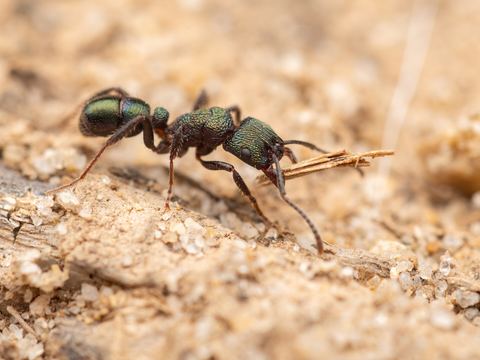
Look for the shine. Green-head ants are 5 to 7 mm long with a metallic sheen that shifts from green-blue to green-purple in the light. Like every ant, they have elbowed antennae and a narrow waist.
Then watch how they move. They forage quickly during the day, on the ground and up among plants. The scientific name is Rhytidoponera metallica, which says it all.
Where they live
Green-head ants are found throughout Australia, in urban areas, forests, woodlands and heath. Their nests are usually in soil, under twigs or pieces of wood, and often at the base of shrubs.
That's why most stings happen in the garden: kneeling to weed, lifting a pot or a log, or sitting on the lawn near a garden bed.
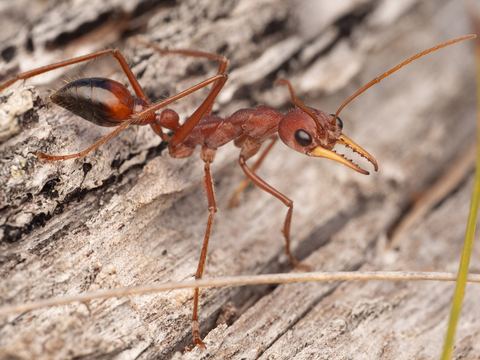
Green-head ant or bull ant?
| Green-head ant | Bull ant | |
|---|---|---|
| Size | 5 to 7 mm | 8 to 40 mm |
| Colour | Metallic green-blue to green-purple | Many have bright red or orange on the head or abdomen |
| Nest | In soil, under twigs or wood, at the base of shrubs | Underground, with hidden or small entrances |
| Sting | Can sting; may cause an allergic reaction | Painful; sometimes causes anaphylaxis |
Other ants people call green ants
Some people use the name for the green tree ant, which lives up in trees in nests made of leaves. We haven't yet checked facts about that ant against an official source, so this page sticks to the green-head ant. If your green ants are in leaf nests in a tree, say so when you tell us what you've seen.
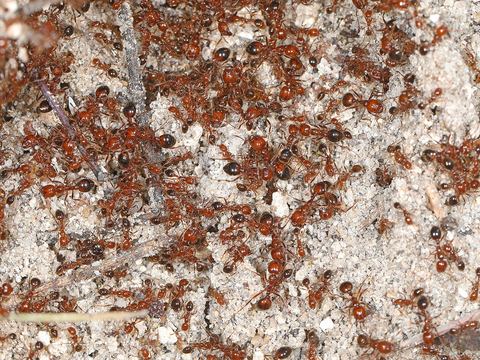
And if the ants are small and coppery brown, coming from a mound of loose soil, read about fire ants and report them first.
Around the garden
You can
- Wear gloves and closed shoes when weeding or moving pots, logs and mulch.
- Show children what the shiny green ants look like, so they know to keep away.
- Note where the nests are, at the base of shrubs or under timber, and garden around them for a while.
Leave to a pest business
- Nests along paths, in lawns or near play areas where people keep getting stung.
- A nest close to someone with a known allergy to ant stings.

In our own garden
Green-head ants are a normal part of an Australian garden, and a nest under a shrub out the back doesn't need anyone. A nest beside the clothesline, in the sandpit or near someone who reacts badly to stings is a different story: tap Spiders or ants and say where it is.
Want someone to look at it?
Tell us what you've seen and your postcode, and a local pest business that handles exactly that calls you to talk it through.