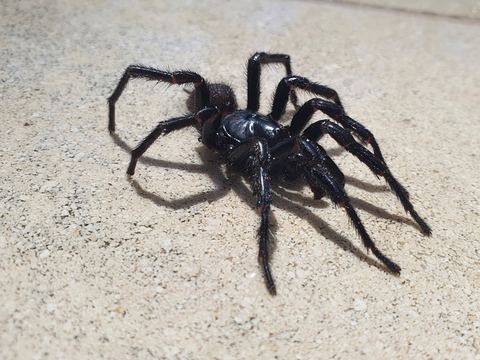
If someone is bitten
Not sure it was a wolf spider, and it was big and black? Treat it as a big black spider bite: call 000 and ask for an ambulance. For a bite you're confident is a wolf spider, Better Health Channel says to wash it with soap and water, hold a cold pack on it for 15 minutes, and get medical help if severe symptoms develop. The Poisons Information Centre on 13 11 26 gives advice any time.
How to identify a wolf spider
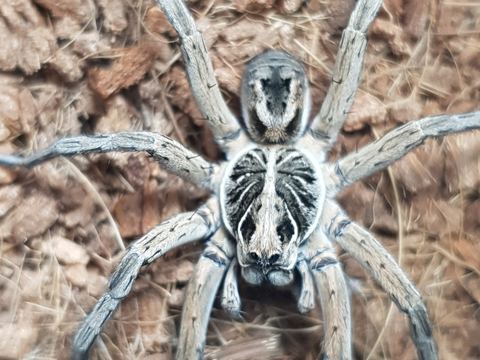
Check the eyes first. Wolf spiders have eight eyes in three rows, and the four biggest form a square on top of the head.
The body is stocky rather than flat, and usually drab: brown and yellow, grey, or black and white. The Australian Museum says many have radiating lines on the front section and scroll-like patterns on the abdomen. Some inland kinds have bright salmon-pink undersides.
Then the giveaway behaviour. A female wolf spider carries her egg sac, a ball of white papery silk, attached to her spinnerets at the back of her body, and after hatching the spiderlings ride on her back until they spread out.
Holes in the lawn
Some wolf spiders wander, while others dig burrows, either open or closed with a trapdoor. The grey wolf spider's burrow has a round trapdoor that's often left open while it hunts. Some woodland species ring the entrance with a fence of twigs, and in dry country some build turrets to keep floodwater out.
The garden wolf spider is common in suburban yards. A scatter of neat round holes in a lawn is often their work, though only the spider coming out confirms it.
Wolf spider, huntsman or mouse spider?
| Wolf spider | Huntsman | Mouse spider | |
|---|---|---|---|
| Body | Stocky, drab, patterned | Often flattened, grey to brown | Bulbous head and jaws, shiny carapace |
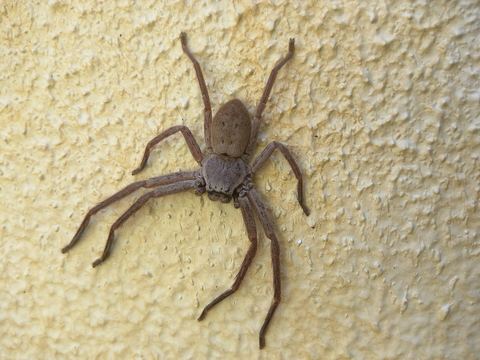
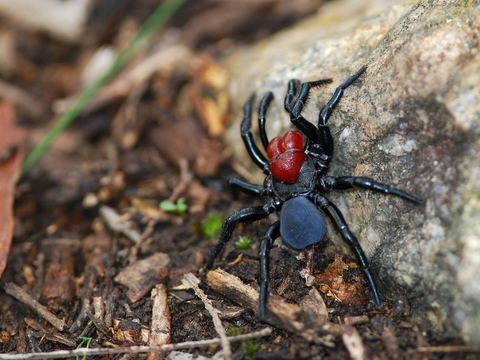
| Look for | A square of four big eyes; an egg sac or babies carried | Legs twisted to spread sideways like a crab | Dark brown to black; some males have a red head |
| Where | Lawns, gardens, under doors | Walls, behind curtains, in cars | Burrows; some males wander by day, especially after rain |
| Bite | Usually minor | May cause short-term swelling and pain | Treat as a big black spider bite: call 000 |
Is a wolf spider dangerous?
Mostly no. The Australian Museum says bites usually cause local pain or itchiness, and less often swelling, prolonged pain, dizziness, a fast pulse and nausea. Better Health Channel says they're not aggressive but can run fast when disturbed, which is usually what startles people.
Keeping them outside
You can
- Fit draught stoppers or seals to the bottoms of outside doors, since wolf spiders come in at ground level.
- Wear gloves and shoes when gardening or moving pots.
- Shake out boots and shoes left by the back door.
- Leave a wolf spider in the lawn alone.
Leave to a pest business
- Spiders regularly coming inside despite door seals.
- Never handle or pick up a spider you can't name.

Our take on the wolf spider
A wolf spider in the garden isn't worth paying anyone to treat, and neither are the burrows in the lawn. We'd seal the gaps under the doors and move on. If they keep turning up inside, or you're finding big black spiders you can't identify, tap Spiders or ants.
Want someone to look at it?
Tell us what you've seen and your postcode, and a local pest business that handles exactly that calls you to talk it through.