If someone is bitten
Call 000 and ask for an ambulance: healthdirect says to treat a bite from any big black spider as a medical emergency. While you wait, healthdirect gives a mouse spider bite the same first aid as a funnel-web bite: keep the person still, apply pressure bandages and splint the limb. Don't wait for symptoms, and don't spend time catching the spider.
How to identify a mouse spider
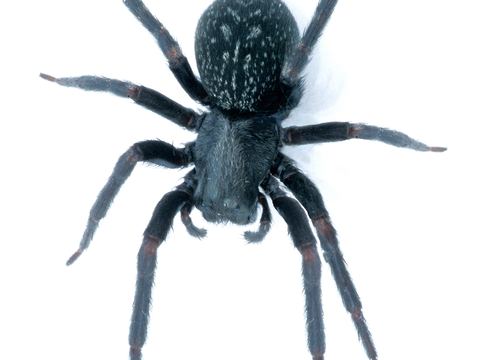
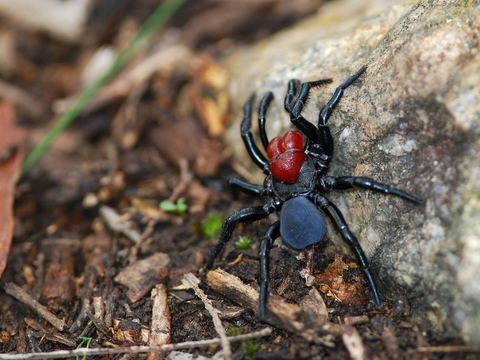
Mouse spiders have a body length of 10 to 35 mm, and their giveaway is a distinctively bulbous head and jaw region. Every female is dark brown to black.
The males are where the colours come in. Some species are black all over. The male red-headed mouse spider has a bright reddish-orange head and jaws, and the male eastern mouse spider carries a pale blue-white patch at the front of the abdomen.
Mouse spider or funnel-web?
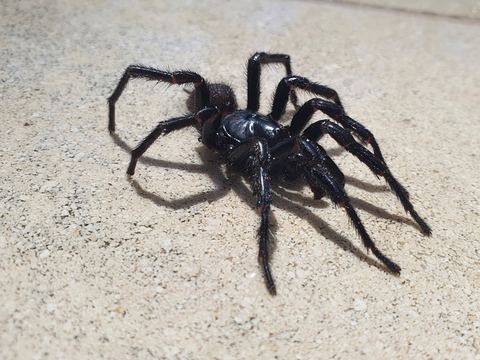
Side by side, the Australian Museum says a mouse spider has a more bulbous head and jaws than a funnel-web, a shiny carapace (the hard front section of the body), eyes spaced further apart, and short spinnerets (the silk-spinning tips at the back end).
Those details are hard to see on a spider running across a floor, and the museum notes the two are easily confused. That's why it advises treating any bite with caution, especially in children, and why first aid doesn't wait for anyone to be sure. Our funnel-web page covers the other half of the comparison.
Where they live, and why you see the males
Mouse spiders are found over much of mainland Australia, in habitats from open forest to semi-arid shrubland, and the red-headed mouse spider has the widest range of them all. They live in silk-lined burrows 20 to 55 cm deep, closed by two trapdoors at the surface, so most of the time you'll never see one.
The ones people meet are usually males out looking for females, from late summer until April and May. Some males wander in daylight, especially after rain, which is when one is most likely to turn up on a path or near a back door.
How serious is a bite?
The Australian Museum says some mouse spider venom is potentially as dangerous as the Sydney funnel-web's, though serious cases are rare. Funnel-web antivenom has proven effective in mouse spider bites. Rare is not the same as never, so get help first and leave identifying the spider for later.
Around the house
You can
- Wear gloves and closed shoes when gardening, digging or lifting anything that sits on the soil.
- Fit a door seal or draught stopper, so wandering spiders have one less way in at ground level.
- Shake out shoes and clothes left outside before you put them on.
- If one is inside, keep children and pets away and watch where it goes from a distance; don't try to catch it.
Leave to a pest business
- A mouse spider inside the house, or one turning up again and again.
- Burrows near play areas, paths or doorways that you'd like checked.

Where we'd start with the mouse spider
If someone's been bitten, the spider doesn't matter yet: call 000 and start first aid. If it's a mouse spider on the patio and nobody's hurt, keep everyone back and take a photo from a safe distance. If they keep turning up, tap Spiders or ants so a pest business can look at the yard and the gaps they're getting through.
Want someone to look at it?
Tell us what you've seen and your postcode, and a local pest business that handles exactly that calls you to talk it through.