Keep the bronze orange bug away from your eyes
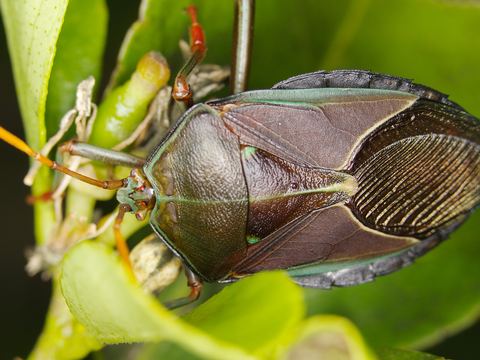
The Australian Museum says the bronze orange bug can squirt a foul smelling fluid that will burn skin and cause great discomfort if it gets in your eyes. Don't handle them, and wear gloves and eye protection if you're working close to a citrus tree that has them. For advice if the fluid reaches someone's eyes or skin, call the Poisons Information Centre on 13 11 26, any time.
The one to report: brown marmorated stink bug
The brown marmorated stink bug is an exotic pest, and as at 27 July 2026 the ACT Government says it isn't established anywhere in Australia. It stows away in cargo arriving from the northern hemisphere between September and April each year, and in cooler months large numbers shelter on and inside buildings and vehicles.
Adults are 12 to 17 mm long, about the size of a 5 cent coin, shield shaped and generally mottled brown, with alternating light and dark bands on the antennae, the legs and the side edges of the abdomen. The ACT Government says they look like native stink bugs, and that the white bands on the antennae are the distinguishing feature.
If you think you've found one, report it to the Exotic Plant Pest Hotline. In Queensland, Biosecurity Queensland also takes reports. It's a biosecurity report, not a job for a pest business.
Which stink bug is it?
| Bronze orange bug | Green vegetable bug | Brown marmorated stink bug | |
|---|---|---|---|
| Size | About 2.5 cm | About 1.5 cm | 12 to 17 mm |
| Where | Coastal Queensland and NSW | Widespread across Australia | Not established in Australia |
| Found on | Citrus and related plants | Vegetables, field crops, garden plants | Sheltering in buildings and vehicles in the cooler months |
| What to do | Keep clear of eyes and skin | Treat it as a garden pest | Report it to the Exotic Plant Pest Hotline |
The bronze orange bug on your citrus
Found in coastal Queensland and New South Wales, the bronze orange bug lives on plants of the citrus family and is common in gardens, especially near the coast. In spring and summer it feeds on young shoots, fruit and flowers, sucking out the juices.
The Australian Museum calls it a minor pest even in commercial orchards in eastern Australia. A handful on the backyard lemon tree is a nuisance for the tree, and the real risk to you is the fluid.
The green vegetable bug in the veggie patch
The Australian Museum describes the green vegetable bug as an introduced stink bug, or shield bug, that can be a serious pest of crops and garden plants. It's widespread across Australia and feeds on a long list of plants, mostly by piercing the fruiting parts and sucking out the juice.
There's a good news story attached. A parasitoid wasp introduced in the 1930s has proved an effective biological control, and the museum counts it among the more successful ways of dealing with this bug.
What you can do
You can
- Check citrus and vegetable plants in spring and summer, including under the leaves.
- Wear gloves and eye protection when pruning or picking from a tree with bronze orange bugs.
- Keep children's faces well back from bugs on citrus trees.
- Photograph any mottled brown stink bug with banded antennae, especially one sheltering indoors or in a car, and report it.
Leave to a pest business
- Usually nothing: stink bugs on garden plants are a gardening job, not a pest control one.
- Bugs sheltering inside in numbers in the cooler months: report them to the Exotic Plant Pest Hotline first, in case they're the exotic kind.

The call we'd make
Stink bugs on the lemon tree or the tomatoes are a gardening problem, so we wouldn't send you to a pest business for them. Keep them away from faces, and ask a nursery about the plants. The exception is a mottled brown bug with white bands on its antennae, especially one sheltering inside: photograph it and report it to the Exotic Plant Pest Hotline.
Want someone to look at it?
Tell us what you've seen and your postcode, and a local pest business that handles exactly that calls you to talk it through.