How to identify a golden orb weaver
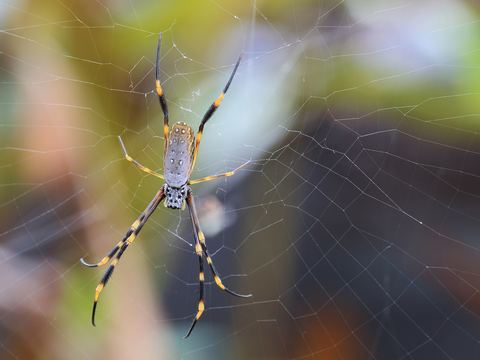
The one you notice is always the female. She's 2 to 4 cm long, with a silvery-grey to plum coloured body and long brown-black legs that are often banded with yellow.
Look around the edge of her web and you may spot the male. He's tiny by comparison, about 5 mm, and red-brown to brown, which is why most people never see him at all.
The web tells you what it is
Golden orb weaver webs are large, strong and catch the light with a golden sheen. They're also semi-permanent: the Australian Museum says golden orb weavers stay in theirs day and night, so you'll see the spider at noon as well as at dusk.
They put the web across openings between trees and shrubs where insects are likely to fly. In a backyard, that tends to mean across a path, between the clothesline and a bush, or along a gap by the side gate.
Where they're found
In the bush they live in dry open forest and woodland, coastal sand dune shrubland and mangroves, and they've adapted happily to leafy suburbs. The Australian Museum's page covers the Sydney region, where two species occur: Nephila plumipes, and Nephila edulis, which is more common inland.
We haven't confirmed their range across the rest of the country from an official source, so we won't list other states here.
Do they bite?
Rarely. The Australian Museum says golden orb weavers are reluctant to bite, and when they do the usual result is mild pain, numbness and swelling around the bite. Now and then nausea and dizziness follow.
healthdirect's general first aid for a spider bite is to wash it with soap and water and use an ice pack to bring down the swelling and pain. For advice any time, call the Poisons Information Centre on 13 11 26, and call 000 if someone becomes very unwell.
Sharing the garden with one
You can
- Walk around the web, or use another path while she's there.
- Stand a garden stake or chair in front of a web at face height, so nobody walks into it.
- Check the clothesline and the side gate before carrying washing through.
- Teach children to look, not touch.
Leave to a pest business
- Webs high under the eaves or around a second storey, where a ladder would be involved.
- Lots of spiders of different kinds around the doors and windows, which a general outdoor treatment covers.
What if the web is right across a path?
The Australian Museum suggests that an orb weaver building across a path you use often may be moved to another site. We'd leave any moving to someone comfortable around spiders, never with bare hands, or simply wait: a web you can see is easy to step around.

Where we'd start with the golden orb weaver
We'd leave her. A golden orb weaver eats the flying insects in your yard, rarely bites, and spins one of the most striking webs you'll see in a suburb. We'd only call a pest business if there were spiders of several kinds crowding the doors and windows as well: tap Spiders or ants.
Want someone to look at it?
Tell us what you've seen and your postcode, and a local pest business that handles exactly that calls you to talk it through.